Improving Educational Stability and Outcomes for Students in Foster Care

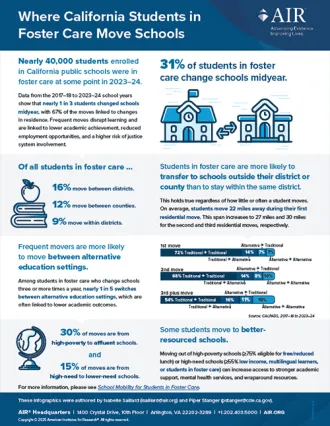
Each year, over 300,000 children in the United States are placed into foster care due to parental neglect, abuse, and/or abandonment, with nearly 40,000 of them enrolled in California public schools. Students in foster care frequently encounter significant barriers to academic success, including high rates of school mobility, developmental delays, and trauma from abuse, neglect, and separation from families.
AIR and the California Department of Education formed a research-practice-partnership to examine educational stability and outcomes for students in foster care, highlighting innovations and challenges.
Study Objectives
- Examine school mobility for students in foster care, and the variations by student characteristics and changes over time.
- Unpack local implementation to learn about how local education and child welfare agencies collaborate to improve educational stability for students in foster care.
- Estimate the relationship between district programs and student outcomes to identify effective strategies that may improve educational stability and outcomes for students in foster care.
- Disseminate widely to researchers, policymakers, and practitioners to inform their decision-making.
Study Activities
- Annual analysis of California statewide data to examine school mobility and academic outcomes for students in foster care, from 2017–18 to 2025–26.
- Annual collection of district documents to identify the types of programs districts have implemented to support students in foster care.
- A longitudinal case study of 7 counties to understand how local agencies develop and implement programs to support educational stability and improve academic outcomes, highlighting local innovations.
- Engagement activities with policymakers and practitioners to share key learnings, disseminate best practices, and inform decision-making on the ground.
Report
School Mobility for Students in Foster Care (August 2025)
Webinar
This webinar from September 30, 2025 includes a discussion of the data and methods, key findings, and next steps related to the study, as well as a demo of the interactive maps for counties and districts. View the webinar slides.
____
This research is supported by the Institute of Education Sciences, U.S. Department of Education, through grant R305S240001 to the American Institutes for Research (AIR). Any errors or misinterpretations belong to the authors and do not reflect the views of the Institute, the U.S. Department of Education or the California Department of Education.