Teach Tech Kentucky: Evaluating the Impact of Computer Science-Focused Teacher Micro-Credentials

Explore this idea with researchers, educators, and policy leaders during a LinkedIn Live event on May 12 from 4-4:30 ET.
In an era when advanced technology is a part of daily life, schools are tasked with preparing students to live in an increasingly computational world. The number of employment opportunities in technology occupations is growing steadily, and there are more jobs available than qualified applicants to fill those positions.
This creates an opportunity for students who pursue education in computer science. As such, students may benefit from early and ongoing access to computer science and computational thinking (CS/CT) instruction. However, few K–12 teachers are prepared to teach computer science, particularly at the elementary and middle school levels.
The Teach Tech Kentucky Evaluation
With support from an Education and Innovation Research grant from the U.S. Department of Education, AIR is partnering with the Ohio Valley Educational Cooperative and BloomBoard Inc. to evaluate a micro-credential teacher professional learning program that focuses on building CS/CT student skills through the Teach Tech Kentucky (TTK) program.
[Students] showed their parents how they code. We did it in class before, so they were like an expert and could teach their parents. I let them show their parents how we use our...robots because they love those, and they were really excited to show their parents how those work.
- TTK Teacher
TTK invites teachers who provide math instruction in Grades 3 through 8 to learn about computer science instruction through online, self-paced modules and ongoing coaching support that prepares them to implement math lessons that integrate computer science and computational thinking.
Teachers may choose to enhance their lessons by using devices made available through a Technology Lending Library. In addition, teachers participating in TTK host a family engagement event through which families have the opportunity to learn about their child’s computer science instruction and future career opportunities in computer science.
To understand program implementation and to test its efficacy on teacher and student outcomes, AIR conducted a two-cohort randomized controlled trial that included approximately 2,700 students in Grades 3–8 taught by 66 teachers across 35 schools in northern Kentucky. AIR researchers assessed the impact on teacher self-efficacy in the use of CS/CT instructional practices and on student math achievement.
Key Findings
Our impact findings indicate that TTK had positive impacts on teacher self-efficacy and practices. TTK teachers were more likely to feel able to effectively teach computer science and computational thinking to their students, to engage parents in computer science learning, and to use CS/CT instructional practices, as compared to teachers who had not participated in the program.
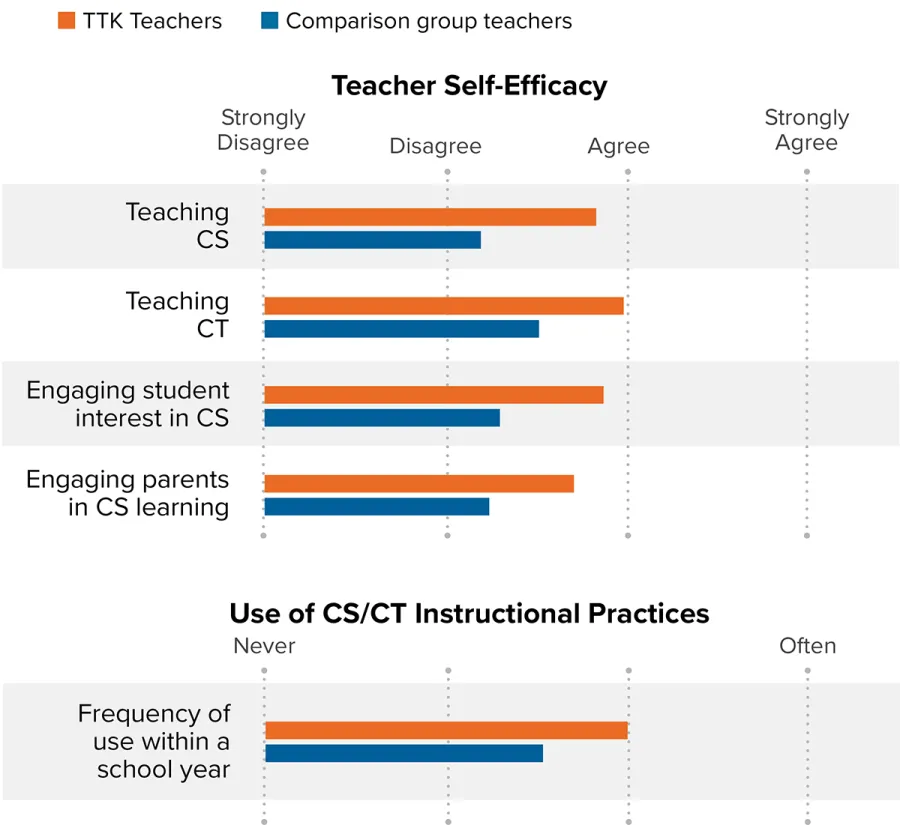
Download the full two-page infographic showing findings from the Teach Tech Kentucky study.
Additionally, we found no evidence of negative impacts on student math achievement, suggesting that integrating computer science and computational thinking into math instruction did not compromise students' math learning.
Our implementation findings show that teachers who continued with the TTK program found it valuable for their instruction and for engaging students and their families. TTK teachers noted high levels of student engagement, and felt the family activities were especially successful in increasing engagement and interest for both students and their families.
This study provides evidence about the possibilities for incorporating emerging technical skills into instruction, starting as young as third grade. These findings can inform current state and district efforts to ensure their students are workforce ready and to evolve content instruction in response to ongoing technological progress.