Early Childhood Cost Study Best Practices
Understanding the cost of early childhood education (ECE) programs and systems is critical for informing policy and funding decisions. Getting accurate cost estimates can be complex, though, as the field uses inconsistent terminology and has a variety of approaches.
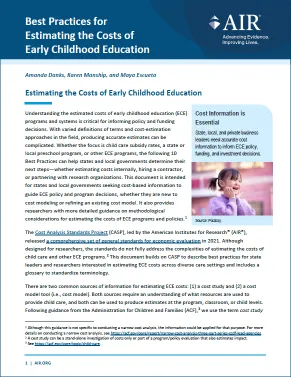
AIR developed the Best Practices for Estimating the Cost of Early Childhood Education guide to help state and local governments make informed decisions about childcare and other ECE programs and policies.
Whether you are in the early phases of creating a cost model or refining an existing one, the Best Practices offer actionable steps to help you. It also gives researchers information about methodological considerations for estimating the costs of ECE programs and policies.
The guide includes ten best practices specific to ECE, categorized across four common research phases: design, data collection, analysis, and reporting. These best practices help estimate or model the costs of a variety of ECE settings, including:
- Center-based care;
- Family childcare homes;
- Care for children with special needs;
- State or local preschool programs;
- Care for children who need overnight, weekend, or evening care; and
- Other scenarios of interest.
State and local governments can use the guide to inform:
- Alternative childcare subsidy rate models;
- The federally required narrow cost analysis;
- The structure of local funding initiatives or ballot measures;
- Supplemental funding decisions; or
- Public/private partnerships.
Plus, the guide can help states and local governments craft requests for proposals to hire a contractor to conduct cost analyses, examine proposal responses, and foster stronger collaboration between states and researchers.
The full brief listed first includes all the documents below it.