Bullying Prevention

The Centers for Disease Control and Prevention (CDC) defines bullying as any unwanted aggressive behavior(s) by another youth or group of youths who are not siblings or current dating partners that involves an observed or perceived power imbalance and is repeated multiple times or is highly likely to be repeated. According to the Indicators of School Crime and Safety: 2019, between 2005 and 2017, the percentage of students ages 12–18 who reported being bullied at school during the school year decreased from 29 to 20 percent; however, rates of online bullying in the 38 states that reported it ranged from 17 to 28 percent.
As more is being learned about the negative psychological and physical effects of bullying, researchers are focusing on how to address the problem. The research and resources featured here relate to efforts to prevent violence in schools and help young people feel safe and supported.
Bullying and Violence Prevention
A Public Health Approach to School Bullying: A Q&A With Xan Young
Xan Young, senior technical assistance consultant at AIR, directs the Violence Prevention Technical Assistance Center, funded by the Centers for Disease Control and Prevention. In this Q&A, Young shares her insights on bullying and AIR’s work on this issue.
Perceptions of Bullying Among Students Who Reported Being Bullied: Repetition and Power Imbalance
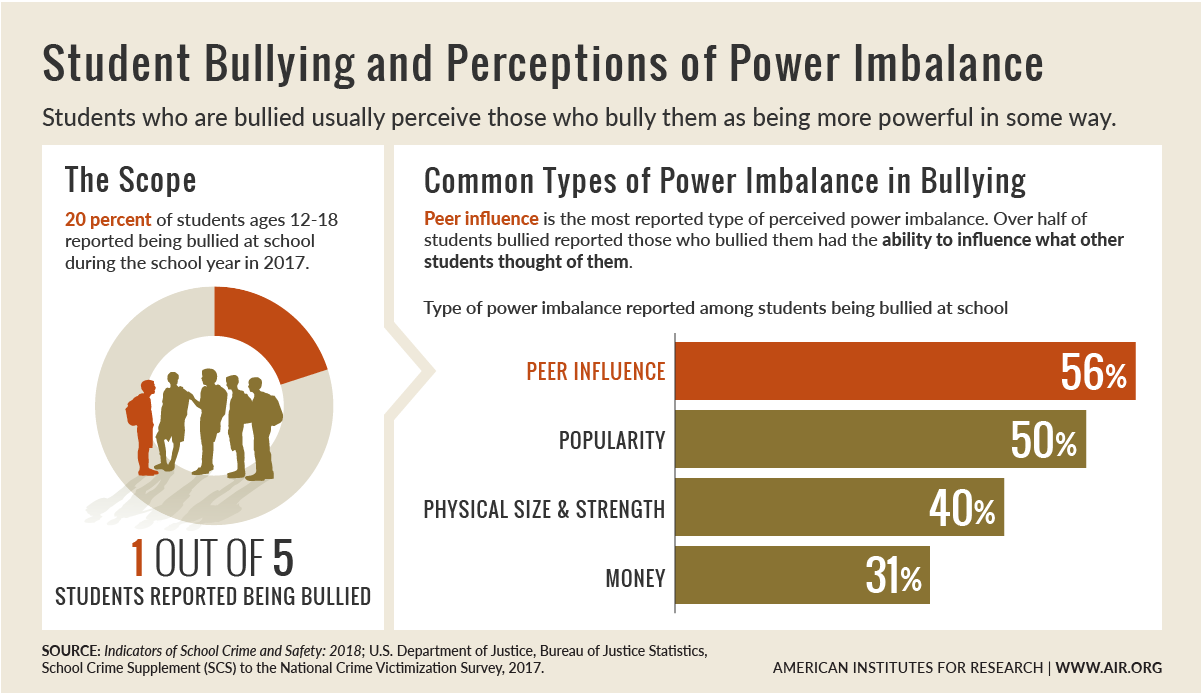
As part of its work on the Indicators of School Crime and Safety: 2019, AIR staff developed a spotlight, Perceptions of Bullying Among Students Who Reported Being Bullied: Repetition and Power Imbalance. This spotlight examines perceptions of bullying among youth who reported being bullied, including whether victims of bullying felt like it would happen again and what type of power imbalance they perceived between themselves and the person who did the bullying.
Bullying Prevention Toolkit
Published in two parts, “Understanding and Intervening Bullying Behavior” and “Creating a Supportive Classroom Climate,” this toolkit helps educators identify, address, and prevent bullying behavior through a series of workshops and exercises.
Cautious Optimism and a Path Forward to Reduce Bullying
Bullying is on the decline, but evidence is mounting that it is even more toxic for children and adolescents than previously thought. In this commentary, David Osher suggests the need for an interim strategy until anti-bullying efforts are in full force, such as the infusion approach, which integrates anti-bullying initiatives into other school-wide activities.
National Resource Center for Mental Health Promotion and Youth Violence Prevention
The National Resource Center for Mental Health Promotion and Youth Violence Prevention seeks to increase effectiveness of youth violence prevention; prevent mental, emotional, and behavioral disorders; and promote safe and healthy school and community environments that prevent youth violence and support the overall well-being of all children and youth.
Positive School Climate
National Center on Safe Supportive Learning Environments (NCSSLE): Bullying/Cyberbullying
The National Center on Safe Supportive Learning Environments offers resources on issues schools and communities face that affect conditions for learning, including bullying, cyberbullying, harassment, and violence.
The Role of System of Care Communities in Developing and Sustaining School Mental Health Services
Schools and communities can play a big role through systems of care to develop supports and services for children and youth with or at risk of mental health or other behavioral challenges.
The definition of bullying and the statistic cited above are from the Centers for Disease Control and Prevention website.