Improving Access to Cash Transfers in Mexico, Brazil, and Colombia
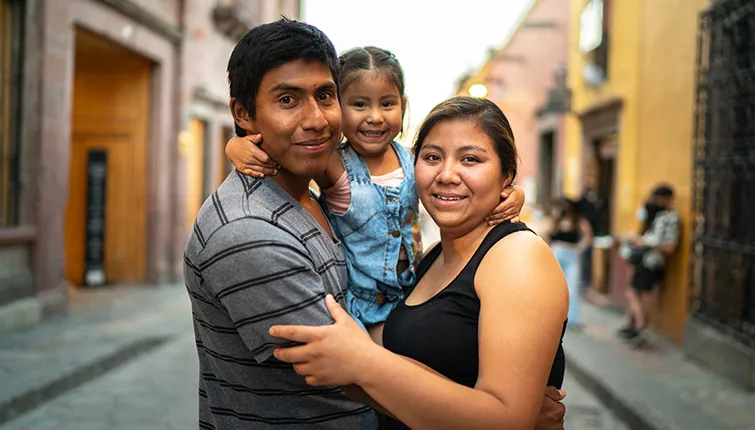
Conditional cash transfer programs in Mexico, Brazil, and Colombia have been central to national strategies for reducing poverty and promoting social inclusion. These programs are designed to provide financial support to low-income households, often tied to conditions such as school attendance or health checkups. While they have reached millions and been a successful policy solution to poverty alleviation, barriers continue to limit access for many eligible individuals.
Factors such as geographic isolation, lack of formal documentation, limited digital access, and administrative complexity can prevent vulnerable, yet eligible, populations from enrolling in or benefiting from these programs.
AIR’s Improving Access to Cash Transfers project seeks to better understand these “exclusion errors” to uncover barriers and facilitators that can make social protection programs more accessible for those who qualify.
With the support of the AIR Opportunity Fund, AIR is leading the the design and coordination of a multi-country research effort using mixed methods to better understand and address exclusion errors in conditional cash transfer programs in Mexico, Brazil, and Colombia.
AIR and its local partners used a mixed methods approach to study exclusion errors in three cash transfer programs, one in each country.
| COUNTRY | PARTNER | PROGRAM |
|---|---|---|
| Mexico Case Study | El Colegio de México | Becas para el Bienestar Benito Juárez program Benito Juárez Universal Scholarship for Well-Being |
| Brazil Case Study | Fundação Dom Cabral | Programa Bolsa Família Family Allowance Program |
| Colombia Case Study | Universidad de los Andes | Familias en Acción Families in Action |
Through literature reviews, key informant interviews, focus group discussions, and quantitative analysis of national program datasets, the project seeks to understand the magnitude of exclusion errors, groups most affected, and the design or implementation factors that lead to excluding eligible populations.
Explore the Evidence
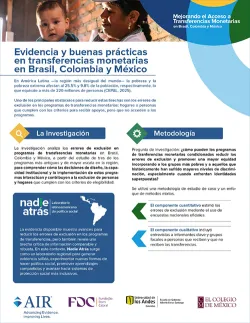
We invite you to discover the key findings from our research on access to national cash transfer programs in Brazil, Colombia, and Mexico. Our policy brief, one-page overview, and recommendations one-pager summarize the evidence, highlight who is being left behind, and outline practical pathways to reduce exclusion and improve access to social protection systems.
- Policy brief: Improving Access to Cash Transfers | Mejorando el acceso a transferencias monetarias
- One-page overview: Descripción de la investigación
- Recommendations one-pager: Buenas prácticas para reducir errores de exclusión
Nadie Atrás: Leave No One Behind
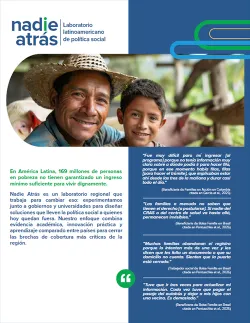
Building on the evidence from our research on exclusion in national cash transfer programs, Nadie Atrás (Leave No One Behind) emerges as the Latin American Social Policy Laboratory for more accessible social protection systems.
The Lab brings together rigorous evidence, innovation, and cross-country learning to identify what works, strengthen public sector capacity, and promote solutions that reduce exclusion—so programs reach those who need them most, even under fiscal and political constraints.
Webinar: Targeting Mechanisms and Exclusion Errors
In this March 2026 webinar, we share key insights from the three country case studies through a dynamic conversation with each’s research lead. The presentation unpacks the drivers of exclusion errors and highlights practical solutions to build more inclusive and accessible systems.